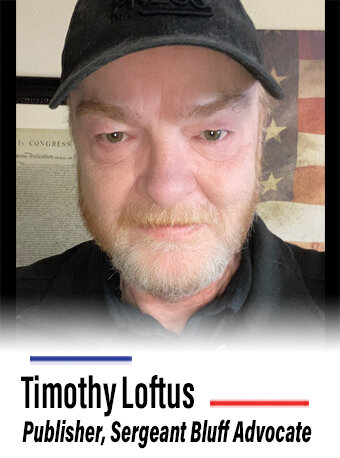
By Timothy Loftus, Editor & Publisher | Sergeant Bluff Advocate
(SBA) - Somewhere along the way, Americans seem to have forgotten that it’s perfectly acceptable to agree with Republicans on one issue, Democrats on another, and neither party on something else entirely. Apparently, having an independent thought these days can be interpreted as a political identity crisis. If you support lower taxes, someone might assume you're a Republican. If you believe everyone deserves affordable health care, someone else might label you a Democrat. Support responsible gun ownership while believing certain safeguards make sense, and you might find yourself explaining your position to both sides. Heaven forbid you believe government should spend taxpayer money responsibly while also helping people who genuinely need assistance. What exactly are you supposed to be? How about an American who can think for themselves?
Political beliefs are shaped by individual experiences, priorities and circumstances, not simply party affiliation. A farmer in western Iowa may view environmental regulations differently than someone living in downtown Sioux City. A retired couple living on Social Security may approach property taxes differently than a young family purchasing its first home. A business owner responsible for meeting payroll might have different concerns about government regulations than an employee focused on workplace protections. These perspectives illustrate why public policies rarely affect everyone equally. Understanding those differences is essential to meaningful discussion, yet our political culture increasingly encourages us to view complicated questions through a narrow partisan lens.
Political campaigns certainly contribute to the problem. Candidates and political organizations have become remarkably skilled at reducing complicated issues to emotionally charged slogans. Instead of discussing the advantages, disadvantages and consequences of a proposal, we're often told what to fear or whom to blame. Campaign advertisements portray opponents in the least flattering light possible, while social media provides carefully selected statements intended to reinforce existing opinions. By Election Day, voters may know considerably more about what candidates supposedly did wrong than what they intend to accomplish if elected. The constant negativity can leave people frustrated, distrustful and reluctant to participate in public discussions.
What I’m finding particularly troubling is how political identity can become more important than the issues themselves. Some people defend practically anything their preferred political leaders say or do, even when those actions contradict principles they previously supported. Meanwhile, proposals that might receive enthusiastic support from one party can suddenly become unacceptable when someone from the opposition suggests them. Imagine applying that philosophy to everyday life. If your mechanic tells you that your car needs new brakes, you're probably not going to refuse the repair because you disagree with his politics. You evaluate the information and make a reasonable decision. Yet in politics, the identity of the person delivering the message sometimes matters more than the message itself.
Look at the discussions surrounding data center development in Salix and Woodbury County. These projects raise legitimate questions about economic growth, infrastructure, water consumption, electricity demands, property rights, tax revenue and the quality of life for nearby residents. Someone can recognize the potential financial benefits of development while questioning whether a proposed location is appropriate or whether sufficient information has been provided about its long-term effects. Another resident may emphasize expanding the tax base or creating economic opportunities. What matters is whether decisions are supported by accurate information, appropriate safeguards and an understanding of who benefits and who bears the costs. Those are community concerns, not exclusively Republican or Democratic ones.
The same reasoning applies to public education, health care and government spending. Supporting strong public schools doesn't mean every expenditure or administrative decision should escape scrutiny. Questioning a school budget doesn't automatically make someone an opponent of education. Likewise, someone can believe government spending should be controlled while recognizing that serious illness shouldn't financially devastate a family. These complicated questions involve competing priorities, limited resources and consequences that cannot be addressed through political slogans. Responsible policymaking requires acknowledging those realities and considering what can realistically be accomplished.
Technology has added another challenge to political conversations. Social media algorithms can repeatedly expose users to familiar viewpoints while limiting exposure to conflicting perspectives. TV commentators, podcasts and political websites compete for attention, and outrage often attracts larger audiences than thoughtful explanations. Consequently, two neighbors discussing the same controversy may discover they've encountered entirely different accounts of what happened. Before debating solutions, they must first figure out what information is accurate. Unfortunately, many conversations never get that far because participants are too busy defending their positions to consider another perspective.
As publisher of a community newspaper, I recognize that readers hold different political beliefs, and I don't expect everyone to agree with everything appearing in these pages. In fact, I would be concerned if that were the case. A newspaper should provide credible information, offer different perspectives and encourage readers to examine issues beyond campaign slogans and social media headlines. That doesn't mean every opinion deserves equal credibility or that factual inaccuracies should go unchallenged. It means distinguishing verifiable information from speculation, asking difficult questions and recognizing that disagreement can contribute to a better understanding of public issues. Readers should have enough reliable information to form their own conclusions rather than being told what to believe.
I also believe we've lost some of our ability to disagree without becoming disagreeable. Not every conversation needs to end with someone declaring victory. Too often, discussions become personal because participants stop addressing the issue and start questioning one another's intelligence, motives or character. Someone's position on immigration, taxes, abortion, environmental regulations or gun laws may be influenced by deeply held values or personal experiences. Understanding those influences doesn't obligate us to agree, but it may explain why another person sees an issue differently. There's nothing wrong with challenging an argument or demanding evidence, but personal attacks accomplish little beyond ensuring that neither participant learns anything worthwhile.
With the November 3 general election approaching, the qualifications and responsibilities of those seeking public office deserve attention alongside their policy positions. Experience, judgment, transparency, ethical conduct and an understanding of the position are all relevant considerations. This is especially true in local elections, where decisions made by county supervisors and other officials can directly affect property owners, businesses, public services and community development. A county road, development agreement or local budget doesn't become more or less important depending on which party supports it. Residents ultimately live with the practical consequences, regardless of who receives the political credit or blame. Local government often deals with practical questions that don't fit neatly into national political debates.
Another troubling part of today's political environment is the reluctance to admit when our opinions have changed. I get it. We’re Americans. We’re stubborn. We can’t even agree on whether the toilet paper roll should face the front or the back. In most areas of life, we consider the willingness to learn and adapt a positive quality. Businesses adjust when something isn't working. Parents change their approaches as children grow older. Scientists revise conclusions when new evidence becomes available. Yet in politics, reconsidering an opinion is sometimes portrayed as weakness. Certainly, elected officials should explain significant changes in their positions, particularly when they've made commitments to voters. But refusing to reconsider a policy simply to avoid criticism can be more damaging than acknowledging that new information warrants a different approach. Changing your mind after examining the facts isn't necessarily inconsistency. Sometimes it's evidence that you've actually been paying attention.
Political independence doesn't require someone to occupy the middle ground on every issue. I can hold strong conservative views about one subject and equally strong progressive views about another. Others may consistently identify with one party because its positions reflect their beliefs. There is nothing inherently wrong with either approach. Compromise isn't always possible or appropriate, particularly when fundamental principles are involved, and disagreement shouldn't be mistaken for a failure of democracy. The greater concern is whether people remain willing to consider information that challenges their assumptions and acknowledge legitimate concerns raised by others.
Here in Siouxland, we see examples of cooperation across political differences every day. People serve together on volunteer fire departments, organize community celebrations, support school activities, contribute to charitable causes and help neighbors facing difficult circumstances. Most of the time, nobody asks whether the person preparing a fundraiser, responding to an emergency or helping a family in need is Republican or Democrat. The work gets done because people recognize a shared responsibility to their community. Political affiliation is only one part of who we are. We're also parents, grandparents, employees, employers, friends and neighbors whose relationships and responsibilities extend well beyond the next election.
When November 3 arrives, Americans will cast their ballots according to their beliefs, experiences and priorities. Some will support candidates from one party, others will divide their votes, and some will be dissatisfied with the choices available. Regardless of the outcome, the challenges facing our communities will remain. Roads will need repairs, schools will need resources, families will face financial pressures and elected officials will have difficult decisions to make. Those responsibilities don't disappear when the campaign signs come down, and neither should our interest in how government addresses them.
Maybe that's something worth remembering the next time someone insists we must choose between red and blue. Our political beliefs don't have to fit neatly inside a campaign slogan, and our relationships shouldn't be defined by the signs in our neighbors' yards.
After all, America's political landscape has never been limited to two colors. It's filled with different experiences, competing priorities, deeply held convictions and countless shades of opinion.
Maybe it's time we started treating it that way.