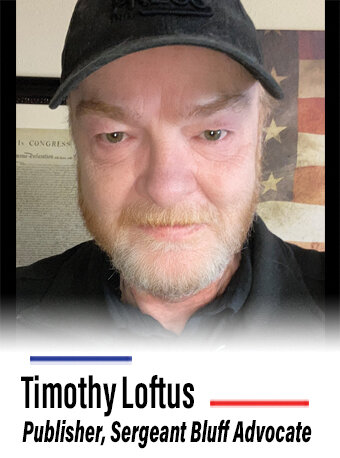
By Timothy Loftus, Editor & Publisher | Sergeant Bluff Advocate
(SBA) - You do realize what our government is trying to do. It’s always statements or news bytes about the “Radical Left” or the “Radical Right,” how the other side is going to destroy our country and our democratic republic.
As a newspaper publisher, I am constantly bombarded by emails filled with sensational subject lines. The tone is always the same — alarm, outrage, and blame. Here are just a few I received last week from Senator Grassley’s office: “ICE Under Fire: The Radical Left’s Crusade Against Immigration Enforcement,” and “Impeachment: Holding Rogue Judges Responsible.” It doesn’t matter which side you’re on anymore; both have made division the centerpiece of their political strategy. And the cost of that strategy is not measured in votes or campaign donations — it’s being paid by the American people, who are watching their trust in government and each other dissolve.
The words coming out of our political leaders’ mouths are no longer about finding solutions or common ground. Instead, every speech, press release, and tweet is crafted to incite anger against the other side.
In Iowa, as in Washington, this cycle of accusation has become the defining feature of public discourse. According to the official transcript of her 2025 Condition of the State Address, Gov. Kim Reynolds said Iowa’s success was achieved “without the bloated bureaucracy and failed promises of Washington,” contrasting the state’s fiscal management with “runaway spending and broken systems at the federal level.” It’s a message designed not just to celebrate Iowa’s success, but to place the blame for national dysfunction squarely on Democrats in Washington.
Not to be outdone, Iowa Republican Party Chair Jeff Kaufmann issued a statement during the October government shutdown calling it “an absolute disgrace that Chuck Schumer and Congressional Democrats voted to shut down the U.S. government.” He accused Democrats of “reckless partisanship” that was “hurting Iowa families and farmers.” A few weeks later, Iowa’s entire Republican congressional delegation — Senators Grassley and Ernst, and Representatives Hinson, Miller-Meeks, Nunn, and Feenstra — issued a joint statement condemning Democrats for the so-called “Schumer Shutdown,” claiming they were “holding government funding hostage to push their radical agenda.”
But before anyone believes that Republicans hold a monopoly on divisive rhetoric, the other side fires back with equal intensity. Iowa Democratic Party Chair Rita Hart, in an August 2025 statement, accused Republicans of passing a budget that “guts Medicaid and food stamps, programs that hundreds of thousands of Iowa children and families rely on.” She added that GOP leaders had “betrayed Iowans and added trillions to the deficit.” Senate Democratic Leader Janice Weiner, in March 2025, blasted Republicans for delaying school funding decisions, saying, “Do your job and stop punishing our schools with wasted time and delays.” Her accusation was that GOP lawmakers were failing to govern responsibly and harming Iowa students. Later that year, in September, Democrats issued another statement accusing Iowa Republicans of “barreling toward a government shutdown” and creating a “massive health care crisis” by refusing to reverse insurance cuts that would remove 110,000 Iowans from coverage.
These aren’t random outbursts. They’re deliberate messages designed to trigger outrage, to frame every issue as a moral battle between good and evil, and to ensure that voters remain angry, fearful, and loyal. According to the Pew Research Center, partisan hostility in the U.S. has reached historic highs, with more than 70 percent of both Republicans and Democrats saying the opposing party’s policies “pose a threat to the nation’s well-being.” In other words, most Americans don’t just disagree with the other party — they see them as dangerous. That level of mutual distrust doesn’t happen by accident; it’s been carefully nurtured by years of messaging from political leaders who have learned that fear and anger mobilize voters far better than facts or compromise.
The tragedy is that this strategy works. Politicians use inflammatory rhetoric because it motivates people to donate, to share, to vote. Every “radical left” headline and every “far-right extremism” accusation gets clicks, drives engagement, and keeps the money flowing. According to data compiled by OpenSecrets, political campaign spending in 2024 exceeded $17 billion — the most expensive election cycle in U.S. history. A large portion of that money was spent not on policy education or civic outreach, but on attack ads designed to vilify opponents. When outrage becomes profitable, moderation becomes obsolete.
The effect on the public is corrosive. Americans no longer trust each other, let alone their institutions. Gallup’s 2025 Confidence in Institutions survey found that only 8 percent of Americans have a “great deal” of trust in Congress — the lowest level ever recorded. Trust in the media, the judiciary, and even local government has declined sharply. Instead of seeing our government as a reflection of collective will, many now view it as a hostile entity captured by “the other side.” This mindset is exactly what foreign adversaries exploit. The U.S. intelligence community has repeatedly warned that adversarial nations like Russia and China amplify divisive content on social media to deepen our internal divisions. According to the Department of Homeland Security’s 2024 Annual Threat Assessment, “the United States remains vulnerable to influence operations that exploit partisan polarization.” We are doing the work of our enemies for them — tearing ourselves apart from within.
It’s worth remembering that the Founding Fathers warned against this very thing. In his farewell address, George Washington cautioned the young nation against “the baneful effects of the spirit of party,” saying it “agitates the community with ill-founded jealousies and false alarms, kindles the animosity of one part against another,” and opens “the door to foreign influence and corruption.” More than two centuries later, those words feel prophetic. The constant state of partisan warfare has become not just a threat to civility, but to the very functioning of democracy itself.
When every issue is framed as an existential crisis, there’s no room left for dialogue. School funding, immigration enforcement, health care, and budgeting — these are complex issues that require nuance and compromise. Yet our leaders treat them as zero-sum battles where one side must be utterly defeated. According to the Brookings Institution, legislative productivity in Congress has declined by nearly 60 percent since the 1990s, with gridlock preventing the passage of even basic appropriations bills on time. That dysfunction trickles down to states like Iowa, where partisan standoffs increasingly mirror Washington’s paralysis.
We’ve reached a point where words no longer aim to persuade, but to punish. When a Republican says “radical left” or a Democrat says “MAGA extremists,” it’s not meant to open discussion — it’s meant to close it. Each side’s rhetoric justifies the other’s hostility. The more extreme one becomes, the more the other feels justified in responding in kind. It’s a vicious feedback loop. According to the American Enterprise Institute, polarization now operates on a “tribal” level, meaning political identity has merged with personal identity. People no longer define themselves by values or principles, but by which side they oppose. Once that happens, compromise feels like betrayal, and empathy feels like weakness.
In practical terms, this division hurts ordinary Americans. Farmers in Iowa don’t care which party caused a government shutdown; they care whether their operations can get federal assistance on time. Families who depend on Medicaid or SNAP benefits don’t benefit from politicians trading insults — they need stable policies and predictable funding. Yet as both parties double down on finger-pointing, programs that sustain millions become bargaining chips. According to the Congressional Budget Office, the 2025 shutdown delayed billions in payments to farmers, veterans, and small businesses. None of those people asked for political theater. They asked for functional governance.
The saddest part is that the majority of Americans are not as divided as their leaders. A 2025 survey by More in Common, a nonpartisan research group, found that about two-thirds of Americans belong to what they call the “exhausted majority” — people who are frustrated by polarization, tired of outrage politics, and yearning for cooperation. These are everyday citizens who believe in both fiscal responsibility and compassion, in secure borders and humane immigration policies, in freedom and fairness. Yet their voices are drowned out by the extremes, whose anger dominates headlines and algorithms alike.
In Iowa, the contrast between rhetoric and reality is especially visible. At the state level, communities still pull together when disaster strikes. When floods hit, when schools need funding, when a neighbor loses their home, Iowans show up for each other regardless of party affiliation. But at the political level, the messages from Des Moines and Washington tell a different story — one where your neighbor is your enemy if they voted differently. It’s a fiction that benefits politicians but harms the very fabric of community life.
According to University of Iowa political scientist Tim Hagle, the state has historically prided itself on civility and bipartisanship. But he notes that “in recent years, that reputation has been eroding as national polarization seeps into local politics.” That erosion is visible in the tone of legislative debates, the conduct of campaigns, and even the way local governments interact with citizens. Social media amplifies it further, allowing unverified claims and inflammatory sound bites to circulate faster than facts.
And it’s not just politicians fueling this cycle. The media — and yes, that includes both national networks and smaller publications — plays a role too. Sensationalism sells. Outrage drives traffic. When a headline screams about the “Radical Left” or “MAGA Fascists,” people click, share, and comment. Nuance doesn’t trend. Outrage does. But as someone who has spent decades in journalism, I can tell you that truth rarely lives at the extremes. It’s found in the middle ground that’s being eroded by constant partisan bombardment.
The responsibility to break this cycle doesn’t rest solely with politicians or the press. It rests with every citizen who refuses to be manipulated by outrage. Democracy depends on disagreement, but it cannot survive contempt. We can debate policy without dehumanizing those who see things differently. We can demand accountability without assuming evil intent. According to the National Institute for Civil Discourse, initiatives that encourage bipartisan cooperation and respectful dialogue have shown measurable success in improving public trust. Communities that foster civil engagement, such as town halls and bipartisan community forums, report higher voter participation and more effective local governance. That proves something vital: when people actually talk to one another instead of shouting past each other, democracy works.
If we continue down this path, where every issue becomes a partisan weapon and every opponent becomes an enemy, we risk losing more than elections. We risk losing the shared sense of purpose that makes a republic possible. History is full of democracies that collapsed not because of external threats, but because citizens stopped believing in one another. The late Senator John McCain once said, “We weaken our greatness when we confuse patriotism with tribal rivalries that have sown resentment and hatred.” His words should remind us that love of country isn’t measured by hatred of opponents.
So when I see press releases from both parties accusing each other of destroying America, I can’t help but think: maybe the real destruction comes from the accusations themselves. Every time one side blames the other for all our problems, every time leaders use fear instead of facts, every time outrage is used as a campaign tool, we chip away at the foundations of the country we claim to love.
The solution isn’t complicated, but it requires courage — the courage to listen, to think critically, to reject propaganda, and to demand better from those who represent us. It means refusing to share divisive posts, refusing to reward politicians who build careers on anger, and insisting that our leaders focus on policy, not personal attacks.
According to the Declaration of Independence, governments derive their “just powers from the consent of the governed.” That consent cannot exist if the governed are divided beyond repair. Our leaders must remember that unity is not uniformity — it’s the willingness to move forward together despite differences. America’s strength has never been in its perfection, but in its perseverance.
The time has come to end the politics of destruction. Both the “radical left” and the “radical right” narratives are illusions meant to distract from the real issues: affordable health care, education, economic opportunity, and the promise of equality under the law. Those are the things that matter to ordinary Iowans, and to Americans everywhere.
If our leaders truly wish to serve the people, they must stop talking about who’s to blame and start talking about what can be done. Until that happens, the greatest threat to our democracy won’t come from abroad — it will come from within, carried in the words of those who claim to protect it.