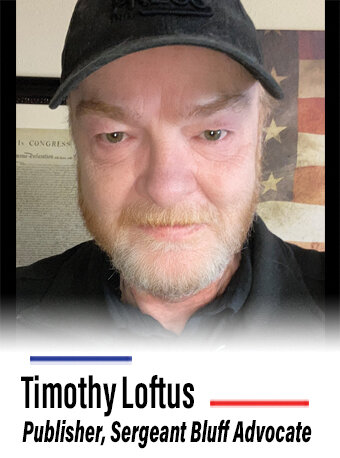
By Timothy Loftus, Editor & Publisher | Sergeant Bluff Advocate
(SBA) - Opinions are like the pink flamingos down in Florida—bright, bold, sometimes amusing, but every once in a while, they bite. And while you won’t see flamingos standing around Kiwanis Park or perched along the Missouri River, you sure see opinions. They gather at Hy-Vee over coffee, they flap around at city council meetings, they squawk on Facebook groups about school board elections, and every so often, one of them sneaks up and nips at you when you weren’t expecting it.
The thing about flamingos is that they stand out. You notice them. Same with opinions. The good ones are worth admiring—balanced, thoughtful, grounded in experience and fact. Like a flamingo in perfect posture, they catch your attention because they carry some grace. Then there are the other ones. Loud, unsteady, maybe even plastic. They don’t hold up under close inspection. You’ve seen these too, the wild theories, the arguments based on memes instead of facts, the kind of chatter that makes you wonder if someone’s cheese slid right off their cracker. And like the late, great “Green Mile” movie moment reminds us, sometimes that cheese really is gone.
But opinions are everywhere, and everyone’s got one. Some people wield theirs with wisdom, citing history, experience, or even a touch of humility. Others fire them off like they’re playing whack-a-mole with reality. You’ve probably sat in a conversation with someone like that—they’ve got an opinion on everything, and yet the moment you ask them for proof, they change the subject. They’re like those Twitter warriors who will argue for three hours that cereal is soup, then vanish the second someone asks for a definition of soup.
The tragedy is that those kinds of opinions don’t stay put anymore. They don’t just stay at the kitchen table anymore. Thanks to the internet, they spread. They multiply. One moment it’s one guy at the VFW claiming wind turbines are secretly messing with GPS signals, and the next thing you know, there’s a whole Facebook thread of folks swearing it’s true. Suddenly, you’re at Thanksgiving and your cousin is repeating it as fact while your aunt is yelling about pineapple on pizza being a communist plot.
It’s at moments like that when Carl Sagan’s words still matter, “Extraordinary claims require extraordinary evidence.” If you’re going to tell me flamingos are secretly government drones, then don’t show me a blurry TikTok with ominous music—show me schematics. Around here, we like proof. Farmers know this better than anyone. You can have all the opinions in the world about when the corn is ready, but if the moisture isn’t right, you’re just wasting fuel and time. The soil doesn’t care about your feelings. The grain elevator doesn’t care about your Facebook post. Facts still matter.
And that’s really the heart of it—facts matter, but opinions matter too. The comedian John Oliver nailed it when he said, “You are entitled to your own opinion. But you are not entitled to your own facts.” That’s the line we so often forget. Some opinions are grounded in truth, experience, or wisdom. Others are floating around like balloons at the Woodbury County Fair—bright and noisy, but mostly hot air.
The best conversations, though, aren’t about “winning.” They’re about the ideas that stay with you. Everyone’s had one of those late-night talks where the conversation zigzags from football to whether life exists in outer space to what kind of pizza should be considered “real pizza.” Around here, I’ve heard more than one spirited debate about whether Casey’s taco pizza is superior to Pizza Ranch, and honestly, those are the kinds of arguments that keep life fun. The good opinions—the ones worth holding—are the ones that make you think, that make you laugh, and that maybe even keep you up a little at night wondering if you might be wrong.
But then there are the other kinds. The ones where you realize you’re not in a discussion, you’re in a hostage situation. Someone is firing opinions like shotgun pellets, and you’re just ducking for cover. These aren’t the conversations that stretch your brain. These are the ones where you’re silently praying for a phone call, a fire alarm, or even a tornado siren to bail you out.
Part of the reason opinions get so messy these days is the rabbit hole problem. Lewis Carroll gave us Alice tumbling down into Wonderland, and now we use that as shorthand for what happens when curiosity goes haywire. You start out with a simple Google search about gas prices in Sioux City, and next thing you know, it’s three in the morning, and you’re watching a YouTube video about how lizard people run Hy-Vee. Daniel Kahneman, one of the greatest minds of our time, nailed it, “A reliable way to make people believe in falsehoods is frequent repetition, because familiarity is not easily distinguished from truth.” And repetition is everywhere—especially online.
That’s why small-town rumor mills feel even more turbocharged now. Mention the Woodbury County jail project three times in line at Hy-Vee, and by the end of the week, everyone’s heard a version of it, no matter how far from the truth it is. The same happens with school funding in Sergeant Bluff-Luton, or ethanol policies, or the latest rumor about gas station chains moving into Sioux City. The more an opinion gets repeated, the more it feels like a fact, even if it started as nonsense.
The irony is, I don’t want to live in a world without opinions. They’re messy, sure, but they’re also what make us interesting. Without them, Friday night football games would be silent, café conversations would be awkward, and no one would care enough to write cranky letters to the editor. Opinions are the spice of community life. They’re what make the guy at the next table lean over and argue with you about whether the Cubs or the Cardinals are better, or whether ranch dressing belongs on everything. Without opinions, Siouxland would be boring.
The trick is balance. As Neil deGrasse Tyson reminded us, “The good thing about science is that it’s true whether or not you believe in it.” Facts stand firm, whether or not you like them. Opinions, though, can be true, half-true, or completely made up. Sorting them out is part of our job as thinking human beings.
And humor helps. When someone insists flamingos are aliens sent to spy on us, sometimes the best response isn’t to argue but to laugh, “Well, if that’s true, they’re doing a terrible job, standing out in the open like that.” The same applies to local debates. When your neighbor swears Casey’s taco pizza is the pinnacle of human achievement, sometimes you’ve just got to smile, grab a slice, and say, “Fair enough.” As Mark Twain wisely wrote, “Against the assault of laughter, nothing can stand.” If more debates ended with chuckles instead of shouting, we’d all be better off.
At the end of the day, opinions aren’t going anywhere. They’ll keep flapping around local coffee shops, county board meetings, and family dinners. Some will be sharp, thoughtful, and worth holding onto. Others will be plastic, wobbly, or just plain silly. The best we can do is keep our balance, keep our humor, and know when to let one go.
Because facts matter. Opinions matter. But don’t be a moron. Don’t chase every rabbit hole. Don’t expect nonsense to be treated as equal to truth. And don’t forget that the flock is always circling. Opinions, like flamingos, may look funny, they may bring some color to the landscape, and every once in a while, they’ll bite. That’s life, even here in Northwest Iowa. The trick is learning how to laugh about it, hold onto the good ones, and let the rest fly away.